Signs Your Tree Needs to Come Down
Not every tree problem is obvious. A tree can look perfectly healthy from the driveway and still be one storm away from coming down on your roof, your car, or a power line. Knowing what to look for can save you from an expensive emergency later — and most of these warning signs hold true whether you're in the Pacific Northwest or anywhere else with mature trees close to a home.
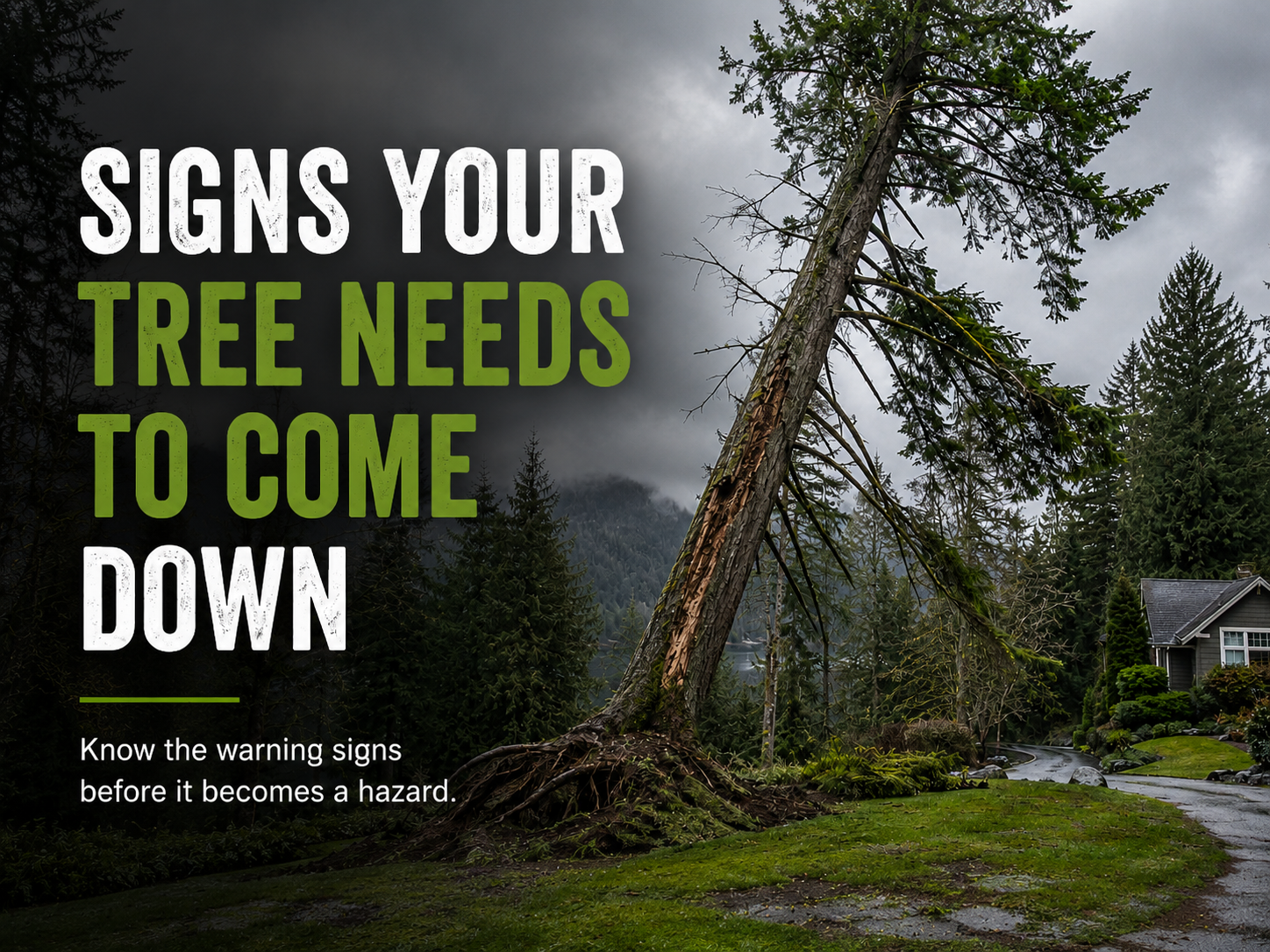
1. Leaning That Wasn't There Before A slight, long-standing lean is often natural. A new or increasing lean — especially after a windstorm or a stretch of saturated soil — can mean the root system is failing. Conifers like Douglas fir and grand fir, common throughout the PNW, are particularly prone to root failure after the heavy, wet winters typical west of the Cascades. If you notice soil lifting or cracking around the base, that tree needs an evaluation soon.
2. Dead or Missing Bark Bark that's peeling away, missing in patches, or has vertical cracks running down the trunk usually points to disease, insect damage, or internal decay. Bigleaf maple and western red cedar, both widespread across the region, can carry significant internal rot while the canopy still looks green — so bark damage low on the trunk is worth taking seriously even on a tree that otherwise looks healthy.
3. Large Dead Branches in the Canopy A few dead twigs are normal. Large dead limbs, especially ones higher in the canopy that are hard to see from the ground, are a real hazard — they can drop without warning, even on a calm day. This is especially true of Douglas fir and ponderosa pine, which can hold heavy dead limbs well above eye level for years before they fail.
4. Fungus or Mushrooms at the Base Mushrooms or fungal growth at the base of the trunk or on major roots is one of the clearest signs of internal rot — laminated root rot and Armillaria root disease are both common in PNW conifer stands. By the time you see fungus, the structural damage is usually already significant.
5. Damage to Nearby Hardscape Cracked sidewalks, heaving driveways, or a sudden tilt in a nearby fence can be a sign that a root system is outgrowing its space or beginning to fail — both can eventually translate into instability above ground.
If any of this sounds familiar, it's worth getting a second opinion before it becomes an emergency. We offer free, no-obligation assessments across Ellensburg, Cle Elum, Roslyn, and the surrounding Central Washington communities — we'll tell you honestly whether a tree needs to come down, needs pruning, or is just fine as-is.
Sources - International Society of Arboriculture, consumer hazard-tree guidance: https://www.treesaregood.org/ - USDA Forest Service, forest and tree health resources: https://www.fs.usda.gov/ - Washington State Department of Natural Resources, forest health program: https://www.dnr.wa.gov/
Related service
Hazard AssessmentHave a Tree on Your Mind?
Free estimate, no obligation. We'll assess your trees and give you a clear, honest quote.